What is a bridge rectifier? What does a bridge rectifier do? How to select a bridge rectifier?
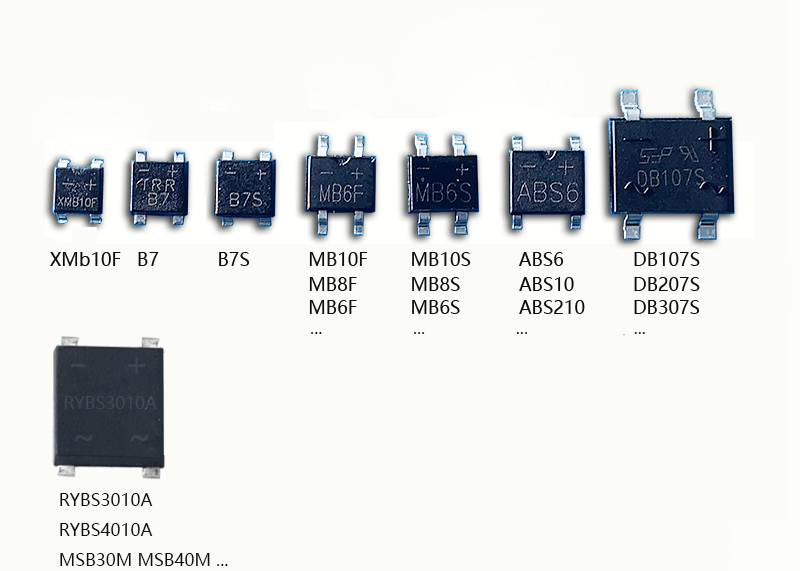
## What is a Bridge Rectifier?
A bridge rectifier is a power semiconductor component integrating four diodes in a single package. Based on the unidirectional conductivity of diodes, it converts Alternating Current (AC) into pulsating Direct Current (DC). It is the essential front-end component for power supplies, battery chargers, inverters, solar systems and emergency power equipmentRS.
Pin marking: two `~` for AC input (no polarity); `+` and `−` for DC positive / negative output.
Note: The output after rectification is pulsating DC. A filter capacitor is usually required to get smooth DC voltage.
## What does a bridge rectifier do?
1. Core function: Rectification, converting AC to DC. Mains power and transformer output are AC, while circuit boards, batteries and controllers require DC power supply.
2. Full-wave rectification uses both positive and negative AC cycles for higher efficiency than half-wave rectifiers.
3. Integrated package replaces four discrete diodes, simplifies PCB layout and improves production consistency.
4. Typical applications: power adapters, LED drivers, solar charge controllers, hand-crank emergency generators, battery chargers, industrial controls and welding machines.
## How to select a bridge rectifier
1. **Repetitive Peak Reverse Voltage (VRRM / PIV)**
Peak AC voltage = RMS voltage × 1.414. Choose a rating with **1.5~2.5× safety margin**.
Example: 220V AC mains, peak ≈311V → 600V or 1000V series (GBU1010, KBPC1010) are widely used. Undervoltage rating leads to breakdown easily under surge.
2. **Average Forward Current IF(AV)**
It defines the continuous DC current the bridge can handle. Select a rating **1.5~2× higher than max load current**. Check surge current IFSM for capacitor inrush current at power-on.
3. **Forward Voltage Drop Vf & Die Type**
- Standard silicon bridge: ~1.4V total drop, cost-effective, preferred for high voltage.
- Schottky bridge: low Vf (0.4~0.6V), less heat, higher efficiency, limited voltage rating, for low-voltage high-current circuits (12V / 24V).
4. **Package & Thermal management**
- SMD (MBS): ≤1A, compact for LED drivers and small power boards.
- GBU / GBJ through-hole: 3A–10A, PCB mount.
- KBPC square bridge: 5A–50A, mount hole, **heatsink mandatory** for industrial / high-power charging.
- High-power rectifier modules: 50A+, insulated baseplate for heavy industrial inverters.
>
> For current >5A, enclosed housing or high ambient temperature, heatsink is required to avoid thermal damage.